You restructured campaigns last month. Spent $75K on new bid strategies. Revenue jumped 12%.
Question: Did your optimization cause that lift, or did your biggest competitor run out of stock?
Most operators can't answer that question with confidence. And when you're managing what's likely your largest expense line—part of the $56 billion Amazon pulls in annually from advertising—that's a problem.
Here's the pattern every Amazon PPC tool follows:
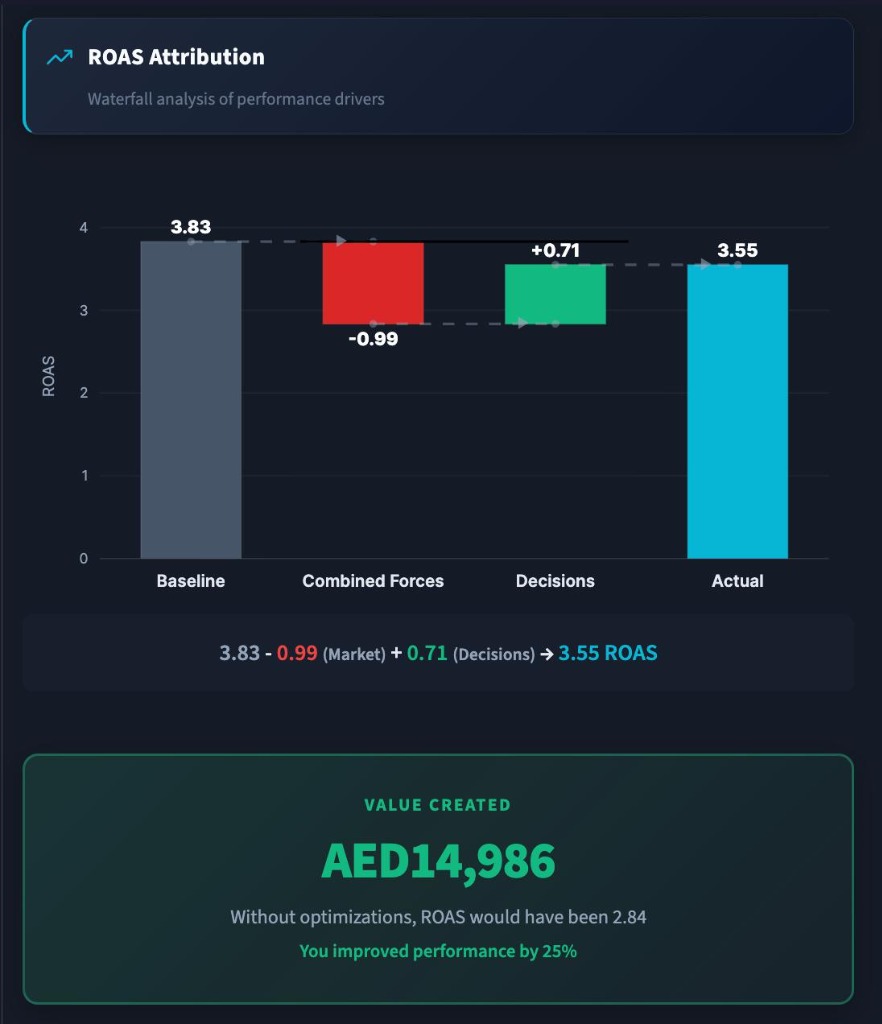
They all stop at the same line: Optimization delivered.
But they never cross into: Impact measured.
"Not because they can't. Because their founding philosophy was activity, not achievement."
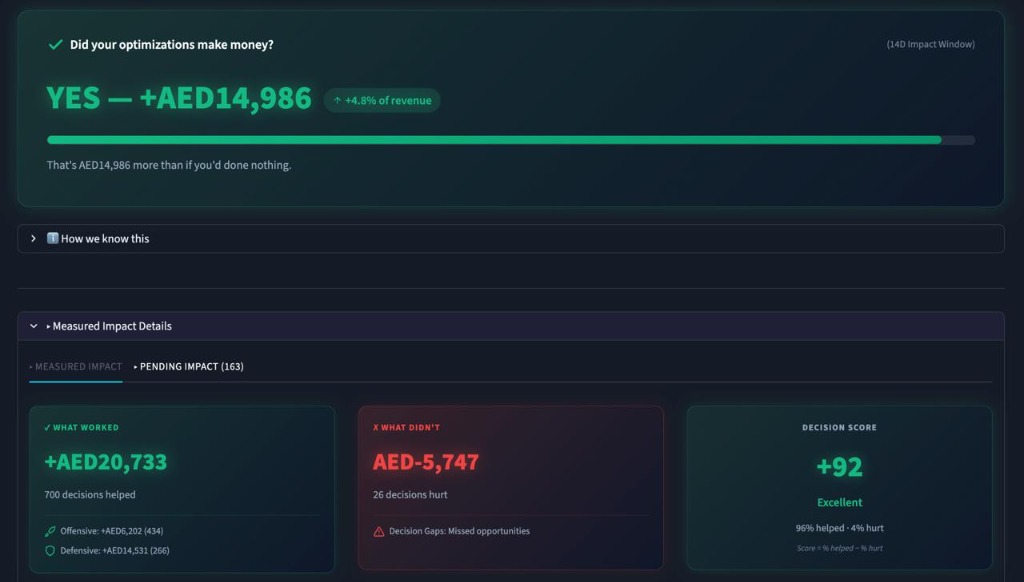
That's the gap. Performance metrics tell you the score. Attribution tells you whether you actually scored or whether the other team just missed.
The distinction becomes critical in today's environment. With paid search ads capturing 27.6% of new visitor traffic and established brands targeting 25% ACoS while new launches accept 40-50% to build visibility, precision matters. The cost of being wrong is measured in tens of thousands of dollars.
Performance metrics tell you what changed, by how much, and when. Clean numbers. Green arrows. Looks authoritative.
Attribution analysis tells you whether it was your action or external factors, how much was baseline versus your lift, and whether you should scale or wait for more data. Less clean. More honest. Actually useful for decisions.
Both are valuable. But decisions require the second layer, not just the first.
What Measurement Actually Means
SADDL measures impact through counterfactual analysis—the same methodology used in traditional advertising for decades. For every optimization you make, we model what would have happened if you did nothing.
That baseline becomes your comparison point. Not last month's performance. Not your gut feeling. A statistically calculated counterfactual using your 30-day historical baseline to model expected performance.
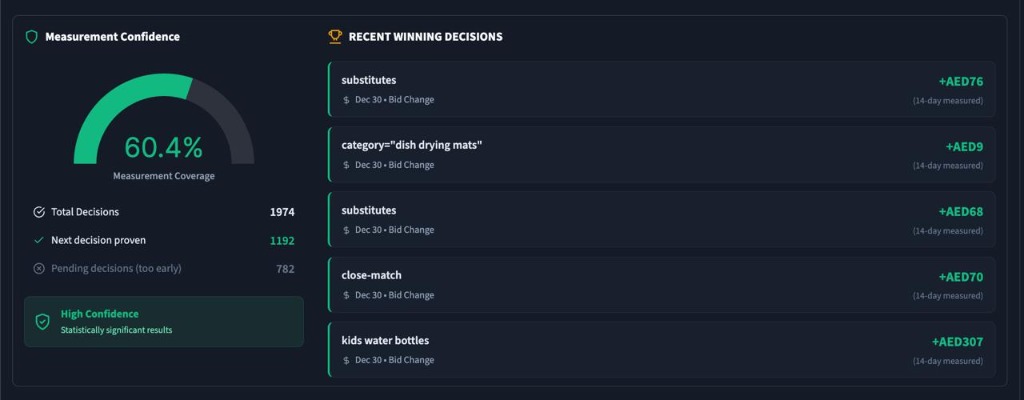
Multi-Horizon Verification
We separate your actions from baseline trends by comparing your target's performance to account-wide averages. We can't always tell you WHY the baseline moved—competitor stockout? Seasonality? Algorithm change? But we can tell you whether your specific optimization beat whatever was happening account-wide. That's the question your decisions actually need answered.
This is what we mean by Decision Infrastructure versus optimization tactics.
Why This Matters More Than Ever
The environment has fundamentally shifted. Amazon PPC is no longer a growth strategy—it's a defense strategy.
In 2020: Growing TAM, lower CPCs, expanding margins. "Optimization probably worked" was good enough.
In 2025: Saturated categories, CPCs climbing toward $1.25, and Amazon capturing $56B annually in ad spend. Every wasted dollar funds your competition.
The question shifts from "how much can we scale?" to "are we solving the right problems?" And you can't answer that without attribution.
How We Crossed the Line
When you've spent years in channels where attribution is standard, you develop an instinct for when it's missing. In TV advertising, if someone claimed a 12% lift without a holdout test, you'd immediately ask: "Compared to what?"
Most PPC tools evolved from campaign automation, trying to add measurement later. SADDL started from the opposite direction: measurement methodology first, applied to campaign decisions.
Dashboard-first thinking: "Here's what happened. Here are 47 metrics. You figure out what to do."
Decision-first thinking: "Should you scale this campaign? Here's the measured impact: +2.4% lift vs. baseline. Validation status: Confirmed. Recommendation: Scale confidently."
It's not a better dashboard. It's a different philosophy.
Case Study: The "False Positive" Trap
Scenario: You restructure campaigns. Revenue jumps 8%. Dashboards show green arrows. The obvious move? Scale immediately.
The Reality: Attribution reveals account-wide revenue was also up 6%. Your biggest competitor went out of stock. That traffic spike was displaced demand, not your optimization.
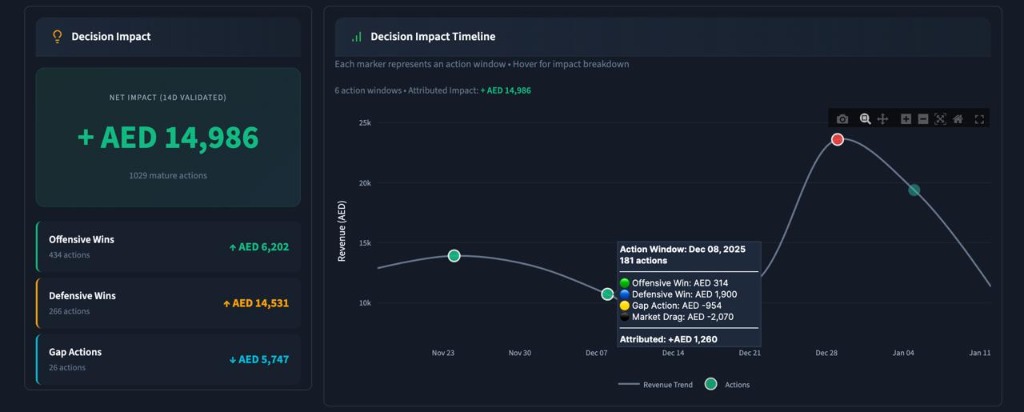
The Outcome: Two weeks later, the competitor restocks. Revenue drops from the peak—but stays above baseline.
Standard tools would have you scaling hard on the artificial high, then panicking during the dip. SADDL measured a "Defensive Win"—you didn't create the spike, but you protected value.
Decision Infrastructure, Not Dashboard Theater
Most PPC tools give you tactics. Bid this keyword at $2.30. Add these 47 negatives. All valuable. But tactics without measurement is activity without achievement.
SADDL gives you Decision Infrastructure. The foundation that lets you confidently answer: Should I do this? Did it work? What do I do next?
You can't afford to confuse correlation with causation. You can't afford to scale on false positives. You can't afford to abandon strategies that are quietly protecting value and building organic momentum.
The Line No One Else Will Cross
Every PPC tool will tell you: "We optimized your campaigns."
SADDL tells you: "Here's the measured impact of what we optimized, separated from baseline trends, with statistical validation."
Stop settling for tactics when you need truth. Take the Saddl.
There's a reason attribution is standard in every other ad channel. Now it's standard in yours.
Ready to measure what actually works?
SADDL brings enterprise-grade attribution to mid-market Amazon PPC. Stop guessing whether your optimizations worked. Start knowing.